Conversation between customer and employee.

Are you leveraging AI to automate processes?
Discover our new groundbreaking AI-powered call transcription service.
Det gør ScriptIQ for dig
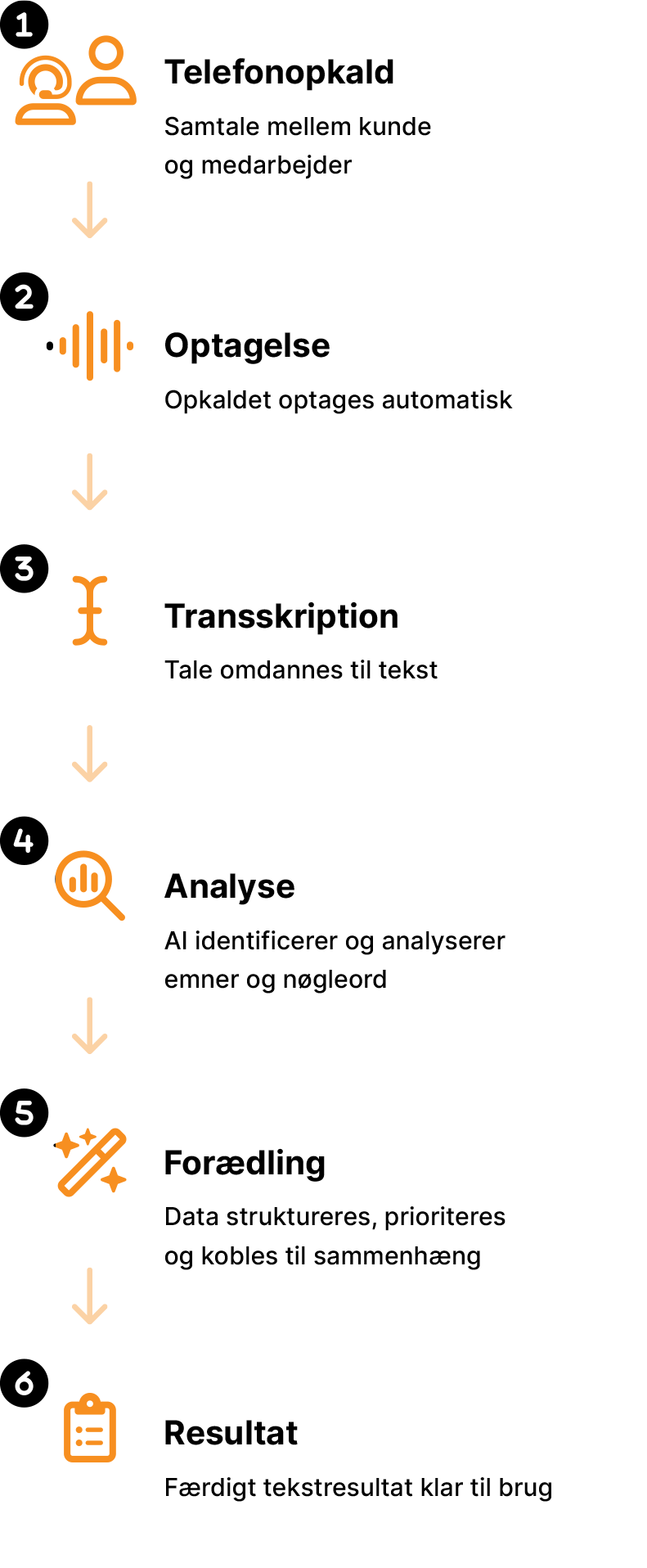
This is what ScriptIQ does for you

1. Phone call

2. Recording
The call is recorded automatically – with no additional action required.
3. Transcription
Speech is converted into text using AI.

4. Analysis
AI identifies and analyses topics, keywords, and content in the conversation.

5. Refinement
Data is structured, prioritised, and placed in the right context.

6. Result
A finished text output, ready to use in your daily work.

Dstny’s AI transcription service – ScriptIQ
AI transcription captures and structures conversations with customers, suppliers, and internal departments. It converts them into actionable data for order management, production, and quality systems – creating a bridge between people and systems.
Practical features tailored for manufacturing companies:
- Order updates and specifications:
The AI transcribes customer conversations and generates precise updates to production orders and technical specifications. - Internal coordination between sales, procurement, and production:
The AI summarizes conversations and automatically distributes relevant information to the right teams. - Quality assurance and claims management:
Conversations are documented as an audit trail within quality management systems and in case of complaints. - Error analysis and improvement areas:
The AI identifies patterns in conversations related to delays, defects, or recurring questions. - Training and onboarding:
New employees can learn from real customer and supplier conversations.
Potential benefits of ScriptIQ

Improved flow between sales and production
- All changes and additions to orders are documented and communicated quickly.
- Reduced risk of production errors due to missing information.

Faster and more accurate support
- Technical support and service teams have access to the full conversation history.
- Solutions are documented and reused.

file-certificate-regular Improved quality and claims handling
- Documentation of verbal agreements and errors ensures faster clarification.
- Less time spent on “what was actually agreed?”

Efficient onboarding and knowledge sharing
- AI-analyzed conversations are used in training programs and internal learning.
- Consistent communication with customers and partners.
Example 1 – Order update
- The customer calls to change dimensions, color, or delivery time.
- The AI transcribes the conversation, updates the order system, and sends a confirmation.
Example 2 – Production error and complaint
- A disagreement arises about what was agreed upon in production.
- The AI retrieves and displays the exact transcription of the conversation between the customer and the sales representative.
Example 3 – Operational analysis
- Many conversations include changes to delivery times.
- The AI identifies the pattern → management adjusts planning and communication accordingly.
Financial benefits
- 20–30% fewer production errors caused by misunderstandings.
- Time savings in order processing and technical support.
- Improved customer satisfaction through proactive and precise communication.
- Lower costs related to complaints and error corrections.
- Faster onboarding and improved performance among new employees.